As a former CISO with over 25 years of experience, I’ve witnessed some of the most damaging security breaches—most of which were caused by Insiders. Insiders refers to employees, contractors, and anyone with legitimate access to an organization’s environment. Whether intentional or accidental, insider actions remain a primary vector for cyber threats.
Common Insider Risks
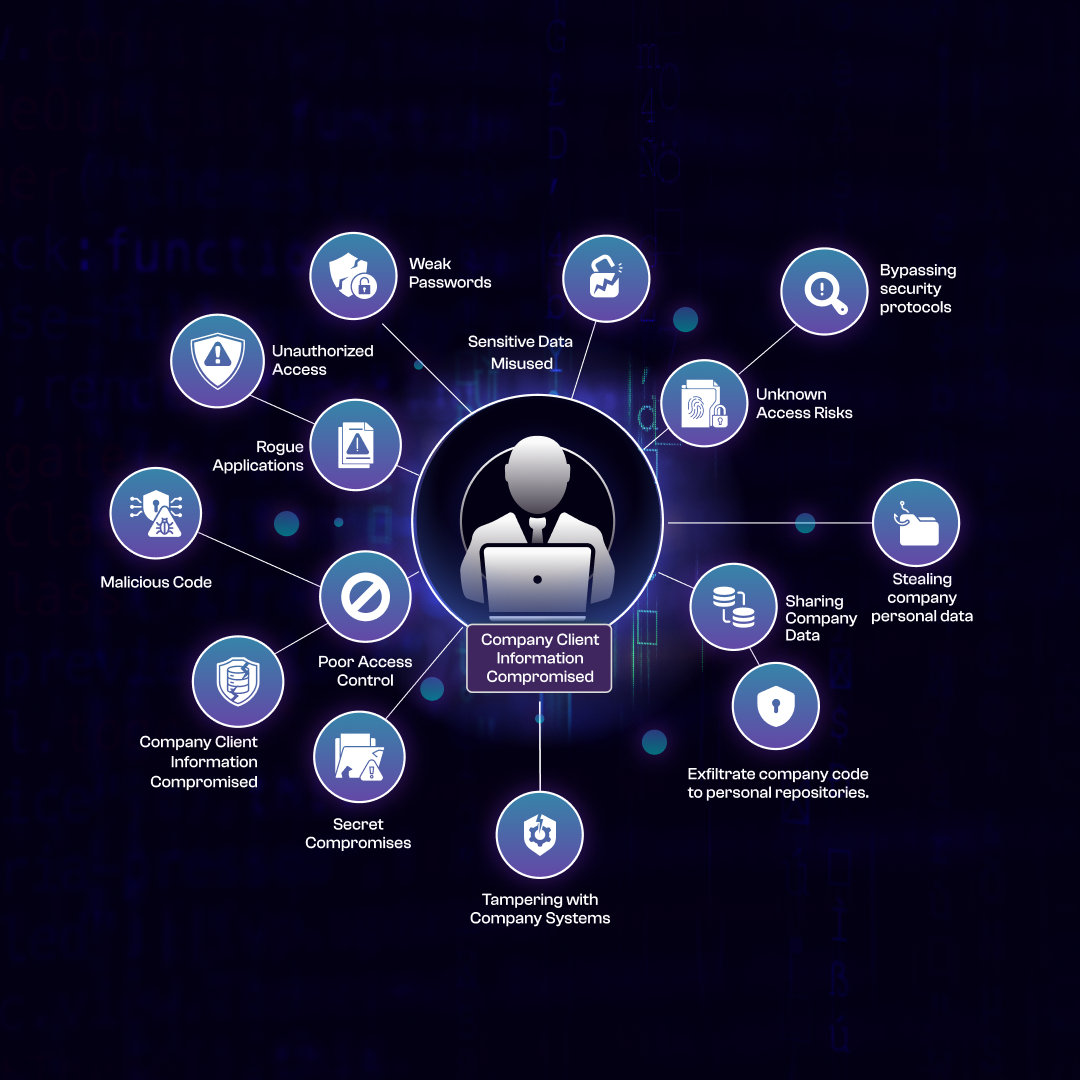
- Insiders often use weak or reused passwords.
- Insiders install rogue applications and browser extensions on company devices.
- Insiders make sensitive data public for convenience.
- Insiders fall victim to repeated phishing attacks.
- Insiders bypass security protocols using Shadow IT.
- Insiders often obtain or retain more access than necessary for their roles.
- Insiders exfiltrate company and customer sensitive data.
- Insiders exfiltrate company code to personal repositories.
- Insiders are socially engineered into leaking company data.
- Insiders leave secrets exposed in code.
- Insiders get corporate machines infected with ransomware.
- Departed insiders retain unauthorized access.
- Insiders bridge home networks to corporate and customer environments.
These examples highlight that
insider risk extends across the entire security program and is not limited to DLP or data controls.
Attackers actively target insiders because they are an effective and often overlooked entry point. These breaches not only compromise sensitive data but also disrupt business operations and weaken organizational resilience.
The Security Gap: Why Current Approaches Fall Short
Despite growing threats, security investments have largely focused on technology and compliance—leaving insider risks inadequately addressed.
Consider this:
If a thief steals your car keys, the car cannot distinguish between you and the thief.
Similarly, a security strategy centered on devices, events, networks, accounts and compliance lacks the context to identify true insider risks.
To secure an organization effectively, security must be people-centric.
The Security Dilemma: Trust vs. Protection
Organizations rely on insiders to act responsibly, but mistakes are inevitable. Security teams face the challenge of
enabling productivity while enforcing strong protections.
So, how can security leaders tackle this growing threat without stifling business operations?
Three Critical Steps to Strengthen Insider Risk Management
1. Enforce Strong MFA (Preferably Passkeys) Immediately
Multi-Factor Authentication (MFA) is one of the most effective controls to prevent unauthorized access.
If you haven’t already implemented phishing-resistant MFA across insiders, vendors and customers, now is the time.
2. Shift to an Employee-Centric Security Posture
Most security tools offer only machine or event-level insights—not a
holistic, user-centric view of risk.
Even when employee-level data exists (e.g., phishing reports), it is often fragmented and fails to provide a complete picture.
Security leaders may assume their existing tools offer sufficient protection, but
without a single, people-centric source of truth, it’s impossible to validate whether security controls are truly effective.
Think of insider risk like a pandemic—you need accurate insights into:
- Who is at risk?
- How many repeat offenders exist?
- What security variants (types of insider threats) are emerging?
- Who is resilient, and who needs additional safeguards?
Time is the most valuable asset for security teams. Reducing noise and
identifying high-risk insiders with precision
is critical to an effective defense strategy.
3. Build Transparency and Training into Your Insider Risk Strategy
Insiders should be aware that
insider risk is being monitored
—not as a punitive measure, but as a way to enhance security and learning.
Mistakes should be
treated as opportunities for improvement
and should drive
targeted user-level controls
rather than broad, restrictive policies.
A
data-driven
approach to insider risk ensures alignment with business objectives.
When security policies are backed by real-world data, they gain credibility and minimize resistance from both leadership and employees.
Final Thoughts
Insider risk is not just an IT issue—it’s a
business-critical challenge.
Addressing it requires a proactive, data-driven, and employee-centric approach.
Security teams must rethink traditional models and adopt strategies that both protect the organization
and empower insiders to work securely.
The question is no longer if insider risk will impact your business—but when.
Are you ready?